November 13, 2025 – The AI hardware market is experiencing a significant boom in 2025, with investments in the first half of the year exceeding RMB 14.5 billion. During the Double 11 shopping festival, AI glasses, toys, and educational tablets emerged as best-sellers. Xiaomi's AI glasses sold over 50,000 units on JD.com, the AI toy "Fuzai" garnered more than 100,000 pre-orders, and learning machines from TAL Education and iFlytek saw robust sales.
As AI applications mature, AI hardware is rising to prominence. According to data released by 36Kr, by the first half of 2025, investment in China's embodied intelligence and AI hardware sector reached 114 deals, with a total funding volume exceeding RMB 14.5 billion. In May 2025 alone, capital flowing into AI hardware accounted for over half of all investments. Products like AI glasses, AI toys, and AI learning machines have moved beyond the initial market cultivation phase and are transitioning from niche interests into the mainstream.
A telling example is the launch of over 100 new smart AI hardware products on Tmall during Double 11, including Quark's self-developed AI glasses, Rokid's smart glasses, and robots from Accelerated Evolution. Smart glasses, smart robots, and AI PCs ranked among the top three trending new categories in Tmall's 3C digital sector.
However, these AI hardware products carry hefty price tags, often comparable to smartphones and tablets even during major sales events. Beyond the influence of underlying AI models and their applications, a fundamental question remains for products across different segments: what specific, compelling value do they ultimately deliver to users? If this question isn't answered convincingly, they risk remaining supplementary "nice-to-haves" rather than essential electronic purchases.
01. AI Glasses: Smartphone Prices, Without a Smartphone's Utility
Many AI glasses brands pinned their hopes on Double 11, offering discounts across various e-commerce platforms.
On October 24, Quark's AI glasses launched pre-sales on Tmall at a price of RMB 4,699. After Double 11 subsidies, the price dropped to RMB 3,899 for general consumers, with Tmall's 88VIP members able to purchase them for as low as RMB 3,329. Within half a day, it topped Tmall's real-time smart glasses chart, and within 11 hours, its sales surpassed the cumulative sales of other brands over nearly three days. The product has sold over 4,000 units, with shipping promised within 60 days.
Another product ranking high on Tmall's XR equipment hot-sales chart alongside Quark was Rokid Glasses, a new product launched in September by Lingban Technology. Priced at RMB 3,299 during pre-sales, its Double 11 price was RMB 2,894. It has sold over 6,000 units, with year-on-year transaction volume on Tmall growing more than sevenfold.
Xiaomi, which launched its AI glasses this summer, also aimed to boost sales during the period. With a lower price point of RMB 1,999 (RMB 1,709 after a 10% discount on JD.com), over 50,000 units were sold on JD.com alone, keeping it at the top of JD.com's smart glasses chart for a consecutive month. Li Chuangqi, head of Xiaomi's wearable department, revealed during the product launch that the Bill of Materials (BOM) cost is approximately RMB 1,290, indicating minimal hardware profit, if any. This pricing strategy likely contributed to the sales of over 50,000 units on JD.com. However, this figure remains a fraction of the volume seen in the smartphone and home appliance markets. Li Chuangqi has publicly expressed a goal of achieving annual shipments exceeding 5 million units for Xiaomi's AI glasses within three years.
While absolute sales figures may not be staggering, growth rates are optimistic, and market expectations for AI glasses remain high. Tmall data shows a 25-fold year-on-year increase in smart glasses sales during the first hour of presales, while JD.com reported H1 transaction volume growth of over 10 times. IDC predicts that China's smart glasses shipments will reach 2.907 million units in 2025, a year-on-year increase of 121.1%.
The positive sales growth is partly because glasses are currently one of the most mature forms of AI hardware, even described as a "portable personal mobile entry point." They offer a sense of hands-free convenience and novelty in tasks like photography, Q&A, payments, and recording. For example, long-pressing the temple touchpad directly activates the AI for interaction, and payments can be made through Alipay with a glance.
However, the functionality of AI glasses is still limited, necessitating interaction with existing hardware ecosystems rather than operating in isolation—which is also a key selling point. Xiaomi's AI glasses aim to connect phones, cars, and smart home devices, while Quark's glasses focus on integration with the Alibaba ecosystem, embedding the Tongyi Qianwen model and deeply integrating with apps like Alipay, Taobao, and Amap. Similarly, Rokid partnered with Alipay to enable "glance-to-pay" functionality.
Consumer acceptance is indeed growing. A 2025 industry report on China's AI glasses indicates that nearly 61% of respondents have purchased or plan to purchase smart glasses, with close to 40% specifically interested in AI-enabled models, with the RMB 2,000-3,000 range being the generally accepted price point.
Despite this, AI glasses have not yet broken out of the niche product category. Sales channels are primarily online, limiting opportunities for firsthand experiential testing, which can impact purchase decisions. Furthermore, a 2024 iResearch report identifies "high price" and the "lack of a killer application or essential use case" as the core barriers to purchase. Essentially, while priced similarly to smartphones, AI glasses have not yet achieved the extensive application ecosystem that makes phones indispensable. Comparing their growth to the early days of smartphones puts the market size into perspective: in 2009, smartphone sales in China reached 21.64 million units, far exceeding the forecasted 2.907 million units for smart glasses in 2025.
02. AI Toys: High User Price Sensitivity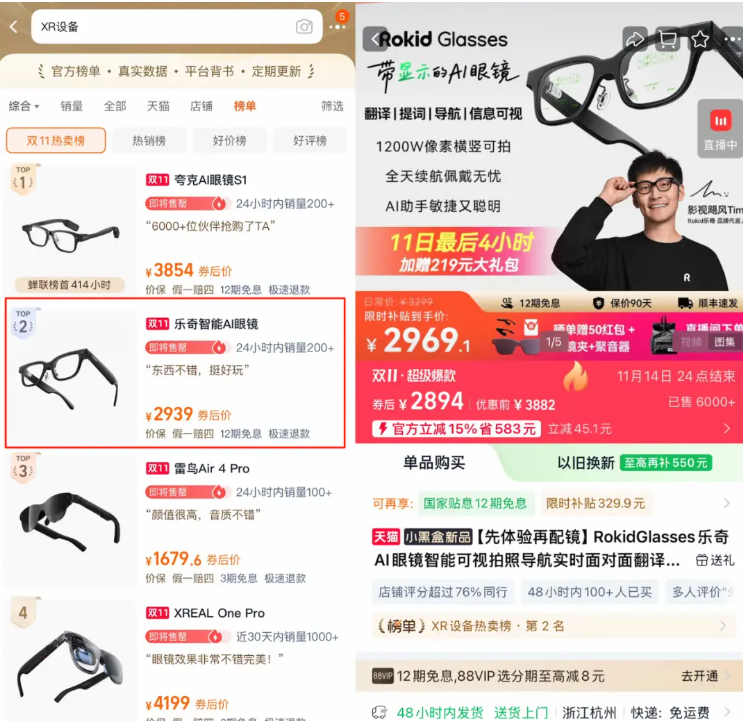
Beyond AI glasses, another hot segment is AI toys. Luobo Intelligent's "Fuzai," an AI trendy toy launched in September, became a hit of the year. Priced at RMB 399 (RMB 369 on Taobao and RMB 329 on JD.com during Double 11), it ranked second on JD.com's AI toy chart. During the June 18 festival, pre-orders surpassed 1,000 within 10 minutes, and current monthly sales have exceeded 20,000 units, with channel pre-orders totaling over 100,000.
The product, resembling a colorful "pom-pom," comes in five colors corresponding to five initial personalities that evolve based on user interaction. Topping JD.com's chart was Beniu Technology's "Niutingting" Hui Ting Niu A3, an AI interactive audio player for children aged 0-12. Integrated with large models from JD.com, Volcano Engine, and DeepSeek, it initiates dialogues based on what a child is listening to. Priced at RMB 999 (RMB 799 during Double 11), it sold over 7,000 units across Alibaba's platforms and over 30,000 on JD.com.
Unlike traditional toys, AI toys incorporate deep learning and affective computing, offering emotional companionship and educational value. This expands their user base beyond children to include young adults and seniors. However, converting these "highlights" into compelling "selling points" is challenging. Prices vary significantly, and consumers are highly price-sensitive, with impulse buys typically capped around RMB 1,000. Sales heavily rely on online channels, driven by social media marketing. The sector faces issues like product homogenization and high return rates, making clear communication of unique value propositions critical.
03. AI Learning Machines: Strong Sales Momentum Continues
If AI glasses are still exploratory and AI toys lack necessity, AI learning machines target a core user pain point and represent the most mature AI hardware category. TAL Education and iFlytek models dominated Tmall's Double 11 learning machine charts. TAL's T4 series (priced between RMB 5,499-6,799) sold over 10,000 units on Taobao and 30,000 on JD.com. iFlytek's T30 series (RMB 6,659-10,959) sold over 10,000 units on Taobao and 5,000 on JD.com.
Despite high prices, sales are growing. Integration with proprietary large models is a key selling point, transforming the devices from knowledge repositories into "intelligent learning partners." Consumers prioritize "educational return on investment" over price. Sales are predominantly online (70.1% in Q3 2025). However, penetration remains low compared to the massive K-12 student population. The key challenge, similar to AI glasses, is justifying prices comparable to high-end smartphones and laptops by demonstrating unique, indispensable educational value. Furthermore, the purchase involves parents (payers) and students (end-users), requiring satisfaction of both parties.
The sales surge during Double 11 signals a shift for AI hardware from niche curiosity towards mainstream consumption. However, for AI glasses, toys, and learning machines to truly become everyday essentials, they must more effectively address rigid user needs and solve fundamental pain points. This will be the true marker of their arrival as mass-market electronic consumer goods.


